In early April I was sitting at my desk in Stockholm, looking out over a beautiful maple tree, when dad shuffled up beside me. I knew what he wanted and was annoyed before he asked in his thick Austrian accent: “Andrew, when you’re ready, could you book me a flight home for the weekend, please?”. Dad had planned three months for this visit to Europe, which was his first since I’d moved over seven years earlier and which, with his advanced cancer diagnosis, we both knew would likely be his last. We had arrived in Stockholm six weeks in. He loved the city, though not its cold, and I knew he was as deeply grateful as I was that he got a chance to see my life in Europe. He was welcome to stay with us for as long as he liked – months if his health allowed – but I could see a familiar restlessness in him. He’d always been someone who couldn’t quite relax into the present moment. No matter how hard he’d worked to get where he was, he was always itching for whatever was just over the horizon. Sure enough, dad let us know that home was calling. I reminded him that he would be greeted by an empty house and we might not get another chance to spend time and explore together. But his mind was made up, and dad was every bit as stubborn as he was impatient.
So, before even two of his planned three months had passed, dad was asking me to send him home that weekend. I objected that since I could actually spend time with him on the weekend, it would be better to wait until next week. He replied, “I already booked myself in for golf on Thursday”. I suggested that he might not need to be three days early for golf so a Monday departure would get him home with plenty of time. Reluctantly, he agreed.
“And that’s a business-class ticket, please”. We’d already talked about that. I reminded him that it would use up enough of his remaining savings that it might prevent further travels should his health hold long enough for him to get bored again after returning home. But he insisted: “I know you think it’s stupid but it’s also ok to spend some money sometimes and for me it’s worth it”. Reluctantly, I agreed.
With a fancy plane ticket on his phone, dad went shopping. He picked out some new trousers, a fine wool cardigan and nice navy jacket. Dad wasn’t just going home on his schedule. He was making a stopover in the prime of his life, when he’d dressed to impress and sat at the front of the plane, drinking champagne and riding high on the success he’d built in his youth.
And so, on that hard-won Monday, this erstwhile businessman and his shambling academic son strolled up to security at Stockholm Arlanda airport, smiled warmly, thanked each other, embraced and said goodbye. In his new outfit, dad looked sharper than I’d seen him in many years. He turned and stepped towards the queue. After a few steps, he paused. He reached up to wipe tears from his eyes, then gathered himself and shuffled on for his date with a luxurious chair in the sky.
—————
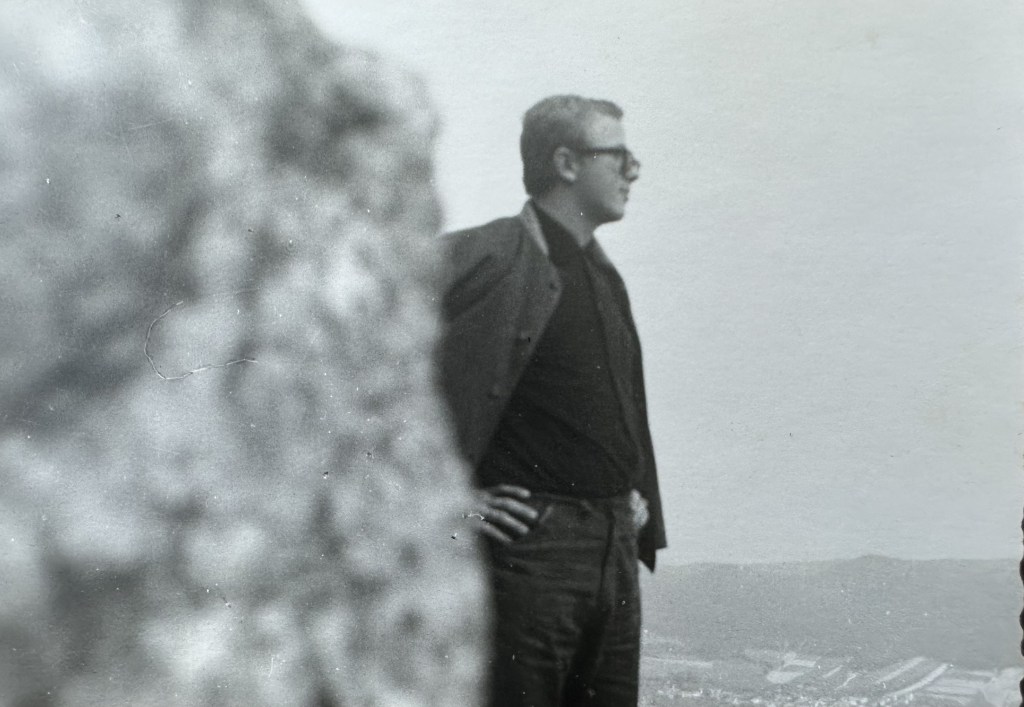
I knew dad as a down-to-Earth, unsentimental guy who joked about life and generally kept things pretty simple. He was grateful for his adventures but I don’t think he saw his life as any kind of special story. But, standing back and taking in the whole picture, it’s hard to deny that he went on a remarkable journey. I won’t drown you in a comprehensive biography, but if it’s ok with you, I’d like to take you on a short tour through dad’s life, at least as I know it, and tell you about a few episodes that I think shaped the man we knew, and how he shaped us in return.
His life did not begin in simple circumstances. Little Helmuth entered the world in Yugoslavia in 1943, two years after it had fallen to the Nazis. His family had lived there for generations and his father, an officer in the Yugoslav army, had fought against the invasion. But their Austro-Germanic heritage still made them unpopular with the Yugoslav Partisans, who resisted the occupiers and attacked perceived associates. When dad was scarcely a year old, his mother took him, his sister and not much else, and fled to Vienna. The treacherous journey, which today takes about five hours by car, took two weeks and dad got sick to the point that his mother thought he might not make it. But in time his little body managed to recover. In Vienna, they took refuge in an aunt’s one-bedroom apartment together with fourteen other people. The reprieve was temporary though, as the Red Army took Vienna the following year. The young mothers hiding out, like my grandma, gave their babies poppy seeds wrapped in handkerchiefs to suck on, to sedate them so they wouldn’t cry and attract attention. Dad didn’t tell me much about those early years, except that he remembered being hungry a lot. His father was eventually able to join his family in Vienna, where he worked odd jobs to scrape by and sometimes walked long distances to find food for the family.
It wasn’t all hard times. The family was eventually able to move into social housing near the Vienna woods, where the kids played and adventured. Some of those adventures included harvesting gifts from the English, American, French and Russian soldiers that occupied the city after the war, much like in Berlin. Dad’s cousin recently told me that he, dad and their friends would make their way to the different occupied quarters where they would usually receive sweets and chocolates, but stockings from the French. The shiny cars driven by the Americans inspired an envy that later became dad’s lifelong love of serial vehicle ownership that I will never understand. The kids also loved to play in a large park — once a royal hunting ground — near their home but would always pause and listen before climbing over the fence to check whether the Russian garrison stationed there was doing any shooting practice that day.
As the city got back on its feet, dad made his way through public schooling. He was a mischievous and middling student but showed keen interest in trade and business from a young age. Upon finishing his compulsory school years at 14, he wanted to go to trade school but his parents couldn’t afford the fees. Lacking any attractive alternative, he undertook a cabinetmaking apprenticeship instead. That sent him on the first steps of his working life but his business instincts took over even before he’d left his teens. It was the late 1950s and as the wave of American modernism swept into Austria, dad got a job selling washing machines and other home conveniences. That “wheeling and dealing”, as he called it, took him all over Austria, drumming up sales and filling orders. In the evenings, he loved going to bars and dancing with girls to rock ‘n’ roll music, which had a special place in his heart for the rest of his life because, as he would say, ‘That rock ‘n’ roll had rhythm”. Some weekends, he would drive with friends and girlfriends down to the beaches of northern Italy. Life was looking up, and once he’d made the move from salaried work to sales and business, he never looked back.
I think the privations of dad’s early life planted seeds of ambition that later drove him on adventures and in business. He knew that life is hard, never took anything for granted, and in his later years saw himself as someone who had pulled himself up by his bootstraps with little help from anyone else. Certainly, with his own son he was permissive and generous to a fault, spoiling me with food, toys and opportunities that he could never have dreamed of at the same age. I later came to feel some resentment for his having spoiled me rotten as a kid. Now I feel only compassion for what he went through and gratitude for his well-intended generosity.
———–
If you’ve ever asked my dad where he’s from, you may have received his standard reply: “I’m an Aussie, I just talk funny.” How did this vaguely Schwarzenegger-sounding guy end up proudly calling Australia home? Like everything else, it began with a woman, and a city, and a little bit of luck. In the ’60s, Australia offered cheap boat tickets and guaranteed jobs to Europeans in an attempt to grow its population. In Vienna, a girl that dad liked told him she had bought such a ticket and was about to leave for a grand adventure to the other side of the world. Twenty-two years old and reeling from his own father’s premature death, dad threw caution to the wind and, together with his best friend, Karl, signed up to join the adventure. There was just one small hiccup: the girl changed her mind and never went. But dad’s mind was made up, and he was every bit as stubborn as he was impulsive.
According to dad’s well-annotated photo album, they rolled out of Vienna central train station at two minutes past twelve on June 3rd, 1965, headed for the Italian port of Genoa. Their boat, the T/N Roma, stopped at two more ports in Italy, then Malta, Egypt, and Saudi Arabia before crossing the Indian Ocean to Fremantle and on to Melbourne. Along the way, dad had his first ever lessons in the English language. From Melbourne, by train once more, they travelled North to the Snowy Mountains, where they joined the effort to build the hydroelectric dam at Jindabyne, which still powers the region today. Dad recalled this as a time of adventure and fun. He told me they would work during the weeks, then stuff the boot of their car full with whatever they thought they might need and drive to either Sydney or Melbourne each weekend for fun. It was also that year that these two boys from Austria learned to ski for the first time. Once they’d worked up some confidence, they got hold of traditional alpine skiing outfits and posed as European ski instructors to impress girls. No doubt this provided some extra motivation for improving their English too, which dad seems to have done with a good ear for the Australian vernacular; until the day he died, he said “G’day mite” instead of “G’day mate”, presumably because that’s what he first heard from the native Aussies around him.
I don’t know what brought the alpine episode to a close but I do know that, the following year, dad and Karl flew out of Sydney, headed for a new adventure in New Guinea, where dad worked in construction and marvelled at the big, loud nature in the tropics. As it happened, a young school teacher from Brisbane, named Patricia, was on her own adventure there. The two met at a party and, a year later, were married in Sydney.
Of all places, next came a stint living in Emerald, a gemstone-mining town in country Queensland, where dad started and jointly ran a construction business. Then, a combination of dad’s homesickness, mum’s keenness to travel, and a half-baked idea to sell Australian sapphires in Europe, took dad and his new wife back to Austria. Dad may have oversold the grandeur that she could expect on arrival, when the couple moved into a crummy little flat with a moisture problem and a shared outdoor toilet. It turned out that Australian sapphires were too dark for European tastes at the time, so dad had to find a plan B. A cousin connected him with a young entrepreneur who was building a confectionery importing company. Dad got himself hired and, over a couple of years, worked his way up to being sales and distribution manager for the company, covering all of Austria. Meanwhile, mum learned German and soaked up the history, art and architecture, but never quite came to terms with some aspects of the culture shock she experienced in the conservative, post-war Austria of the 60s and 70s.
After five years, my parents found homesickness and another business idea pulling them back in the opposite direction. While dealing with confectionary producers in Europe, dad had discovered that many hadn’t known where Australia was, let alone found a market there. This time, the business idea turned out to be more thoroughly baked. Starting out of a small flat and garage in Sydney at the age of 31, dad began to build his own confectionery importing outfit. Putting his travelling sales experience to work, he established a network of customers along the coast from Brisbane to Adelaide. He was a hard worker, meticulously well organised, a shrewd negotiator and got lucky with enough product choices that things went well. He also, it should be said, had support from mum in the early days, as she was back to teaching and bringing in the stable paycheques that kept food on the table. A few years later, they managed to find space in their flat to park their new son, too.
By the time dad was 40, as I am now, he’d set himself and his family up well enough to retire in style. Like most young people who manage to find success, he didn’t manage to stop it going to his head. Even as a kid I grew sick of hearing him talk about the business he’d built, the money he’d made and the toys he’d bought with it. He never quite grew out of the habit, even when, or perhaps because, the money eventually dwindled, and I never quite grew out of cringing at it. But when I zoom out and see that behind the puffed-up success story stood a starving refugee who was denied the education he’d wanted but still managed to make good in that very field, in a foreign culture on the far side of the planet, I again feel compassion and gratitude for the conditions of my own childhood, which could have been very different.
My parents made a sea change from bustling Sydney to beachside Noosa where, at the time, as dad described it, “You could cross the road without looking”. They bought some land by Lake MacDonald and dad dusted off his construction experience to direct the building of a house that mum, who was a frustrated architect at heart, had designed. I had the privilege to live out my childhood while taking that beautiful place for granted, getting lots of time and care from my parents, who had the privilege to choose how they spent their time while raising a child. Later in life, dad told me that when he looked back, one of the things for which he felt most grateful was the freedom he’d had to spend time with his kid instead of having to work all the time. I didn’t know how lucky I was.
Still, there’s only so much time that a man like him could stand playing children’s games. Dad needed a hobby. One benefit of living on acreage is that there’s plenty of room to hit a golf ball. I clearly remember dad, in his 80s polo shirts, whacking white balls far into grass that was sometimes too long for him to find them again until they flew out the side of a mower weeks or months later. I had a lot of fun though, joining him on the search. It’s nice to know I managed to give something back.
Anyone who knew dad could have seen that retiring young was pointless for such a relentless entrepreneur. While many would have been content to manage their home, raise their son and play golf three times a week, dad got bored before long. He started another importing business – though not lollies this time – and although he managed to keep the lights comfortably on, he craved something different. Little surprise then, that he soon let a guy he hardly knew talk him into planting out his property with 50,000 palms and other popular landscaping plants, for sale to, well, whoever was buying. Dad the cabinetmaker, salesman, builder, and importer was now a palm farmer. Once again he made it work, though never at the heights of his earlier enterprise, and I remember having great fun riding my motorbikes up and down the endless rows of palms.
Sadly, marriage didn’t run as smoothly as business. My parents separated and eventually divorced. That was not an easy chapter for any of us and it taught me that having shiny things is no substitute for authentic, loving relationships.
My folks went their separate ways when I went off to university. Dad bought himself a motorhome and did some very-Helmuth grey-nomadding. The Australian mainland coastline is 36,000 km long. Dad went around it in a couple of months and was very satisfied with his efficiency. Then he got bored at home so he went around again and ventured out into the Outback too, on some of the country’s toughest roads. His photo albums from those trips testify to his love of Nature in all its forms, which I’m grateful to have inherited.
Feeling unsure what to do next after his travels, dad visited me in Brisbane and proposed that he and mum, who were now on friendly terms, could buy a home in Brisbane as tenants in common, with a space for me to live during my student years. I told him I’d be grateful for the cost saving but only if he would, for the first time in his life, commit to smoking outside. Reluctantly, he agreed.
I’m very grateful for the role that dad played in my young adult life. Supportive and guiding but never controlling or trying to live vicariously through me, he settled into a simpler life of reading books, playing golf and keeping his daily routine, which was one of his greatest comforts. In these years I knew him as an odd combination of social and antisocial, loving his golf and being friendly with neighbours but almost always shying away from social invitations that put him outside of his comfort zone. I’m happy that he had golf as his social anchor throughout later life, also because the exercise presumably helped to compensate for his endless smoking.
When my long student years were finally over and I gathered my things to set off for an exciting new chapter in Europe, it was a shock to dad’s system. I clearly remember him crying as we said goodbye on the front verandah. I reassured him, “I’m not dying, dad.” He retorted, “Yeah but I might be”. I promised him that if and when he needed me home, all he had to do was say so and I’d be there.
Even from the other side of the planet, dad was caring and reliable. We communicated mostly through text messages, of which we sent thousands over the seven years between my departure and his. He got the hang of the emoji palette before long and signed most of his messages, even the ones about daily trivia, “Lots of love, dad”.
COVID kept us apart for three years; time that I now wish had been ours to use better. When my partner, Elli and I finally managed to get back to Australia in September last year, dad was complaining about some strange discomfort in his stomach. He’d always had a sensitive tummy, so he suspected it was some kind of food problem. But even with dietary adjustments, things only got worse. He eventually caved in to my pleas to see his doctor but, as luck would have it, he got one piece of bad medical advice after another. This, together with an increasingly ill-financed and sluggish medical system, delayed him getting the endoscopy he needed. When he finally went private, with the help of his golf mate, Gary, it was clear that he had cancer that was already quite advanced.
Just before Christmas, he finally called me home from Europe. He’d rocketed up the medical priority list and was due for surgery in a few days. He’d also been given a substantial chance of not making it through, and he wanted me home with him in case we wouldn’t get another chance. Elli and I scrambled and were there less than two days later. That left us one day to try to do whatever one is supposed to do when facing the possible imminent death of a loving father. I asked him the list of questions that I’d come up with in a hurry, trying to make sure that we left nothing important unsaid. We took photos, made videos and wrote down passwords and login details.
Happily, dad made it through and healed like a champion after the operation. Less happily, the pathology results from his tumor told us that his health would be temporary. His doctors recommended against chemo and encouraged him to make the trip he’d told them he wanted to make: to visit Europe, see lifelong friends and family, see my new life there, and say goodbye.
I’ll remember those two months with great fondness. We travelled together as two grown men and as friends. I did my best to return a small fraction of the care and guidance that he’d given me over 40 years. He returned to the city of his birth in what is now eastern Croatia and made good on his wish to see those family and friends, thank them and say a final farewell. It had been a dream of mine for dad to show me around the Vienna of his childhood, so I could see it through his eyes. My dream came true. And I got it all on video.
But I still couldn’t help being annoyed when he shuffled up beside me that day, asking me to book him a ticket home. This was it; didn’t he understand? This was the time we had left and I didn’t want him to go. But if life has taught me anything, it’s that love is for the people we have, not the people we wish they would be. And dad was every bit as consistent as he was impatient.
If I’d known that our farewell at the airport that Monday would be the last time I’d see him, I would have held him longer and told him all the things I had to say. But he left in good health and the doctors had told us to expect months even after his symptoms returned. When I got a call from the hospital just three weeks after dad started complaining of symptoms again, they told me to get on the next plane. I took off five hours later but it was too late. While I was somewhere over southeastern Europe, dad’s failing organs gave up and he was gone. That guy just couldn’t bloody help leaving early.
————–
Dad was my most reliable ally of 40 years. He gave me more than was given to him and more than any son could have reasonably asked for. Among his many gifts were a sense of humor and willingness to take life as it comes. I like to think that he’d be happy with these reflections on his life but he’d probably also think I’ve been a bit over-the-top. So, dad, one last time, let me just say thanks. I’ll see you at the 19th hole.

 ANDREW RINGSMUTH
Leave a comment